5 minute read

1. What is GEA-All charge?

In compliance with ERC Resolution No. 06, Series of 2025, the Green Energy Auction Allowance (GEA-All), a fixed charge amounting to PhP0.0371/kWh, will be included in the electricity bill of all customers starting January 2026 billing. GEA-All will be used to fund renewable energy projects like solar, wind, and hydro in the Philippines. It supports the Green Energy Auction Program (GEAP), a government program where renewable energy projects are selected through competitive bidding to ensure the lowest possible cost for customers. The GEA-All rate is subject to change upon approval of the ERC.

This is a pass-through charge collected by Distribution Utilities, such as Meralco, Retail Electricity Suppliers (RES), and National Grid Corporation of the Philippines (NGCP) to be remitted to the National Transmission Corporation (TransCo). Meralco does not earn from this charge.

2. Who will be charged with the GEA-All charge?

All captive customers, including residential, commercial, industrial, and flat-rate streetlight (FSL), are charged with GEA-All.

3. How much is the additional cost to my bill?

Starting January 2026 billing, customers will be charged the ERC-approved GEA-All rate of PhP0.0371 per kWh.

For residential customers consuming 200kWh, the impact on the bill will be an additional PhP7.42.

4. Where can I find GEA-All in my bill?

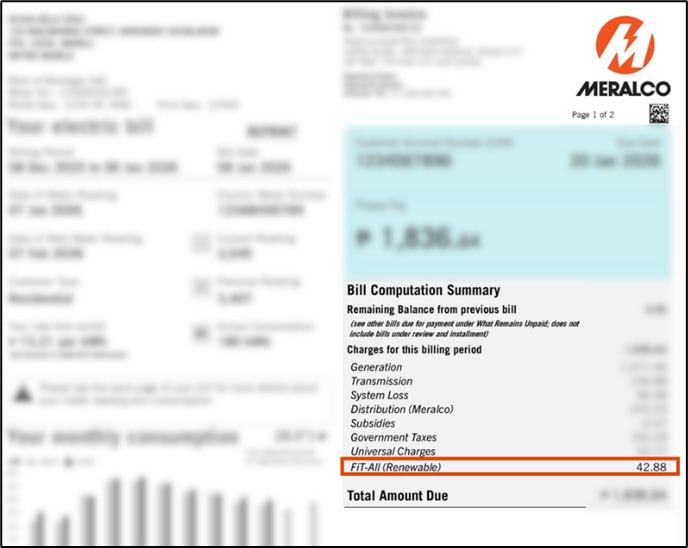
For January 2026 Meralco bills, the GEA-All charge will be temporarily combined with the FIT-All charge and shown as “FIT-All & GEA-All (Renewable)” on both the front (bill summary) and back (rate components) of the bill. The combined rate is PhP0.2382/kWh, reflecting the sum of the FIT-All charge (PhP0.2011/kWh) and GEA-All charge (PhP0.0371/kWh).

January 2026 Bill Front

Front of the bill

January 2026 Bill Back

Back of the bill


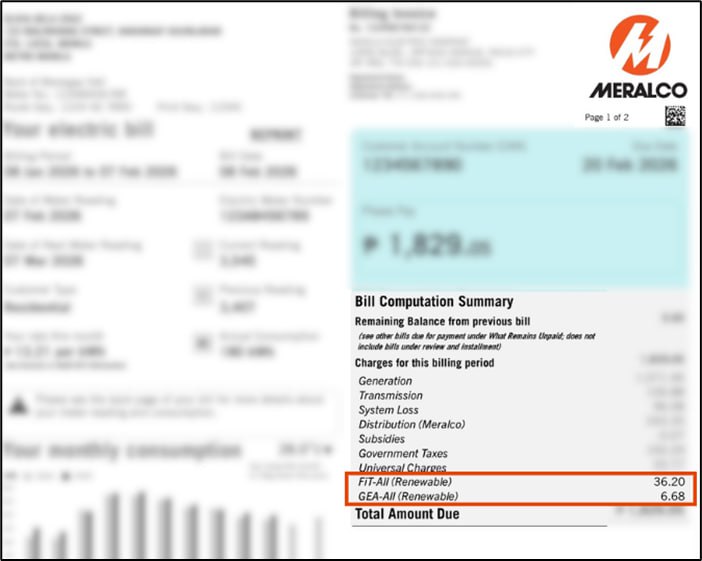
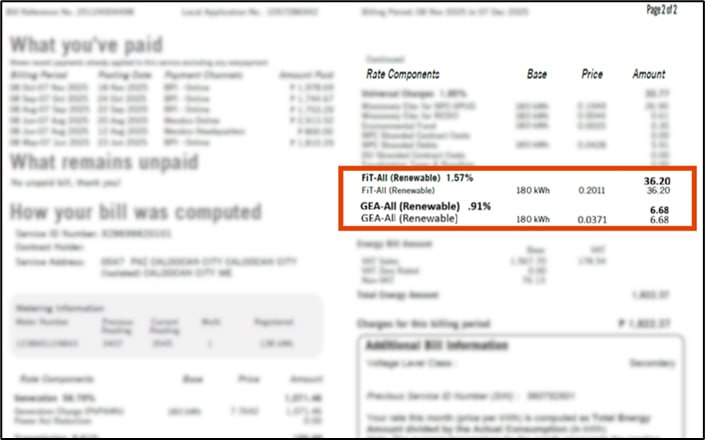
Starting February 2026, the GEA-All charge will appear as a separate line item on Meralco bills, both on the front (bill summary) and back (rate components).

February 2026 Bill Front

Front of the bill

February 2026 Bill Back

Back of the bill

5. I am already being charged the FiT-All for the government’s renewable energy projects. Why am I also being charged the GEA-All?

The Feed-In Tariff Allowance (FIT-All) and the Green Energy Auction Allowance (GEA-All) both support the government’s renewable energy programs, but they serve different purposes and apply to different incentive mechanisms.

FIT-All is a charge collected to support older renewable energy projects under the Feed-in Tariff (FIT) System. FIT is a government program that guarantees fixed payments to eligible renewable energy developers for many years, with rates set by the government.

GEA-All, on the other hand, supports new renewable energy projects under the Green Energy Auction Program (GEAP). While GEAP has the same objective of promoting renewable energy development in the Philippines, it uses a competitive bidding or auction process where renewable energy developers compete to offer the lowest prices,

6. I have already invested in a renewable energy system for my home/business installed and I also contribute clean energy to the grid. Can I not be charged with GEA-All?

We appreciate your efforts to shift to clean energy. However, Distribution Utilities, such as Meralco, Retail Electricity Suppliers (RES), and the National Grid Corporation of the Philippines (NGCP) are mandated to collect the GEA-All from all customers under the ERC Resolution No. 06 Series of 2025.


Common Questions

In compliance with ERC Resolution No. 06, Series of 2025, the Green Energy Auction Allowance (GEA-All), a fixed charge amounting to PhP0.0371/kWh, will be included in the electricity bill of all customers starting January 2026 billing. GEA-All will be used to fund renewable energy projects like solar, wind, and hydro in the Philippines. It supports the Green Energy Auction Program (GEAP), a government program where renewable energy projects are selected through competitive bidding to ensure the lowest possible cost for customers. The GEA-All rate is subject to change upon approval of the ERC. 

This is a pass-through charge collected by Distribution Utilities, such as Meralco, Retail Electricity Suppliers (RES), and National Grid Corporation of the Philippines (NGCP) to be remitted to the National Transmission Corporation (TransCo). Meralco does not earn from this charge. 

All captive customers, including residential, commercial, industrial, and flat-rate streetlight (FSL), are charged with GEA-All. 

Starting January 2026 billing, customers will be charged the ERC-approved GEA-All rate of PhP0.0371 per kWh. 

For residential customers consuming 200kWh, the impact on the bill will be an additional PhP7.42. 

For January 2026 Meralco bills, the GEA-All charge will be temporarily combined with the FIT-All charge and shown as “FIT-All & GEA-All (Renewable)” on both the front (bill summary) and back (rate components) of the bill. The combined rate is PhP0.2382/kWh, reflecting the sum of the FIT-All charge (PhP0.2011/kWh) and GEA-All charge (PhP0.0371/kWh).

January 2026 Bill Front

Front of the bill

January 2026 Bill Back

Back of the bill


Starting February 2026, the GEA-All charge will appear as a separate line item on Meralco bills, both on the front (bill summary) and back (rate components).

February 2026 Bill Front

Front of the bill

February 2026 Bill Back

Back of the bill

The Feed-In Tariff Allowance (FIT-All) and the Green Energy Auction Allowance (GEA-All) both support the government’s renewable energy programs, but they serve different purposes and apply to different incentive mechanisms. 


FIT-All is a charge collected to support older renewable energy projects under the Feed-in Tariff (FIT) System. FIT is a government program that guarantees fixed payments to eligible renewable energy developers for many years, with rates set by the government.  

GEA-All, on the other hand, supports new renewable energy projects under the Green Energy Auction Program (GEAP). While GEAP has the same objective of promoting renewable energy development in the Philippines, it uses a competitive bidding or auction process where renewable energy developers compete to offer the lowest prices, helping keep costs more affordable for consumers.